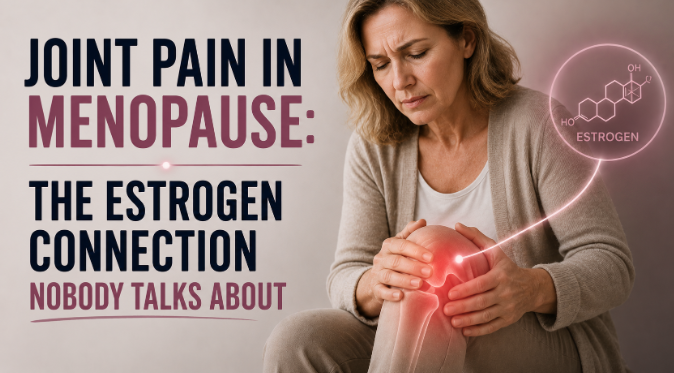
She was 47 and had been seeing a rheumatologist for two years. Her knees ached. Her hips felt stiff every morning. Her hands had started to bother her at the end of the workday. The rheumatologist ran tests, found nothing dramatic, and told her she was “just showing some age-related changes.” She left with a recommendation to take ibuprofen as needed and to lose a little weight.
What nobody told her was that her joint pain had started within six months of her periods becoming irregular. What nobody told her was that estrogen, the hormone her body was producing less of with each passing month, had been quietly protecting her joints for decades.
This connection between estrogen and joint health is real, well-documented in the research, and almost never discussed in the average clinical setting.
Estrogen Does Far More Than You Think
Most people think of estrogen as a reproductive hormone. It regulates cycles, supports fertility, and then declines at menopause. That’s the common understanding.
What that understanding leaves out is how much estrogen does for the rest of the body, including your joints.
Estrogen plays a role in cartilage integrity, the health of the connective tissue that cushions your joints. It also affects bone density, lubricates joint surfaces, and dampens certain inflammatory signals. When estrogen is plentiful, the body has a kind of built-in anti-inflammatory buffer working on your behalf.
Think about why menopausal women experience dry skin, dry hair, and vaginal dryness. Estrogen has a lubricating effect on tissues throughout the body. The joints are not immune to this. When estrogen drops, that lubricating effect diminishes, and the joints feel it.
Testosterone also plays a role here. In women, testosterone at appropriate levels helps reduce inflammatory signaling and supports muscle tone and strength. Muscle strength matters for joint support, particularly in the knees and hips. When both estrogen and testosterone decline together, as they often do in perimenopause and after, the joints become more vulnerable on multiple fronts.
The Perimenopause Window Is Long
One of the most important things to understand is that hormonal decline does not happen overnight. Women can experience fluctuating and declining sex hormones for 10 to 15 years before they are technically considered menopausal, which is defined as 12 consecutive months without a period.
During that long perimenopause window, many women begin noticing joint stiffness, achiness, and reduced range of motion. These symptoms may be mild at first. They may come and go. But the pattern often tracks with the hormonal changes, appearing or worsening as cycles become irregular.
Conventional medicine rarely connects these dots. A woman in her mid-40s complaining of joint pain will typically be sent to a rheumatologist or orthopedic specialist. Those providers will look for structural problems, autoimmune markers, and injury. If the workup comes back clean, she may be told the pain is idiopathic, meaning the cause is unknown, or attributed to early arthritis with no further investigation.
The question of hormone status, in most conventional settings, does not come up.
The Gut and Inflammation Are Also in the Picture
Joint pain is rarely caused by a single factor. Even when hormonal decline is the primary driver, the body’s inflammatory environment matters enormously.
The gut-joint axis is a real and increasingly well-studied phenomenon. An imbalanced gut microbiome can generate systemic inflammation, and that inflammation reaches the joints. Gut permeability, often called leaky gut, allows bacteria to enter the bloodstream in a way that activates the immune system. Over time, that immune activation contributes to joint damage and pain.
Certain specific gut bacteria have even been linked to specific forms of arthritis. Rheumatoid arthritis is associated with overgrowth of a bacteria called Prevotella copri. Osteoarthritis is connected to more general bacterial overgrowth and resulting inflammation.
Diet adds another layer. Nightshade vegetables, including tomatoes, peppers, eggplant, and cayenne, contain chemicals that are specifically pro-inflammatory to joint tissue. Gluten, particularly in its modern genetically modified form, has significant links to joint pain. When women eat foods that feed inflammation while their estrogen levels are declining and their gut protection is compromised, the joints get caught in the crossfire.
The problem in chronic joint pain is not simply inflammation itself. It is the failure of inflammation to turn off. The body has built-in mechanisms to resolve inflammation, but those mechanisms depend on adequate nutrients, a healthy microbiome, and hormonal balance. When any of those are missing, the inflammation becomes self-perpetuating.
Why Conventional Treatment Keeps Women Stuck
The standard approach to joint pain involves anti-inflammatory medications, corticosteroid injections, and eventually surgical consultation if the pain becomes severe enough.
None of these address the hormonal contribution to joint vulnerability.
NSAIDs reduce inflammation acutely, but they do not correct the underlying drivers. Worse, long-term NSAID use damages the gut lining, which can worsen the very gut imbalances that are contributing to the inflammatory cycle. A woman taking ibuprofen daily for joint pain may be inadvertently making her gut, and eventually her joints, worse over time.
Corticosteroid injections suppress inflammation at the injection site, but synthetic corticosteroids carry their own risks with repeated use, including effects on bone density, which is already compromised by estrogen decline.
Surgery replaces damaged joints, but it does not address why the joints deteriorated in the first place.
The functional medicine question is different. Instead of asking how to suppress the symptom, it asks: what is causing this inflammation, and why is the body unable to resolve it?
What a Root-Cause Approach Looks Like
When a woman comes in with joint pain in the context of perimenopause or menopause, a thorough functional evaluation looks at several things simultaneously.
First, hormone status. A comprehensive hormone panel that includes estrogen, testosterone, and progesterone gives a real picture of what the body is working with. Not just total testosterone, but free testosterone and bioavailable testosterone, which show what the body can actually use.
Second, gut health. A comprehensive stool analysis can reveal microbiome imbalances, inflammatory markers at the gut level, and opportunistic infections that are contributing to systemic inflammation.
Third, nutritional status. Deficiencies in omega-3 fatty acids, vitamin D, zinc, and magnesium are common in women with chronic joint pain. These nutrients play direct roles in the body’s ability to resolve inflammation. Without them, the body cannot turn off the inflammatory response, no matter how many anti-inflammatories are taken.
Fourth, medication review. Certain common medications, including proton pump inhibitors for acid reflux and SSRIs for mood, have documented effects on bone density and can compound the joint vulnerability that hormonal decline creates.
Fifth, movement patterns. Cardiovascular exercise alone is insufficient for joint health. Weight-bearing and resistance exercise creates the mechanical stress that bone and joint tissue need to stay dense and strong.
Bioidentical HRT as One Tool
For women whose joint pain tracks with hormonal decline, bioidentical hormone replacement therapy can be a meaningful part of the solution.
The goal is not to eliminate all symptoms with a single intervention. It is to restore the hormonal environment that kept joints healthy in the first place, while simultaneously addressing the other contributors.
Transdermal estrogen, applied as a cream or patch, is the preferred delivery method because it does not carry the blood clot risk associated with oral estrogen. Progesterone is typically added in oral form. Testosterone, when included, is applied topically and dosed carefully to stay within physiologic ranges for women. Peptides that target connective tissue and have anti-inflammatory properties can complement the hormonal work, particularly in women who are close but not quite where they want to be after hormone optimization.
Joint pain that has been written off as “just aging” often has more specific, addressable causes underneath. The hormonal piece is one that thousands of women never hear about, because the specialists they see are not the specialists who would think to check it.
If your joint pain arrived or worsened in your 40s or around the time your cycles changed, that timing is telling you something. It is worth asking the question that most providers will not think to ask.
About the Author: Dr. Sasha Rose is a naturopathic physician and licensed acupuncturist at Med Matrix, a functional medicine clinic in South Portland, Maine. She specializes in women’s hormone health, bioidentical hormone therapy, and root-cause approaches to perimenopause and menopause.